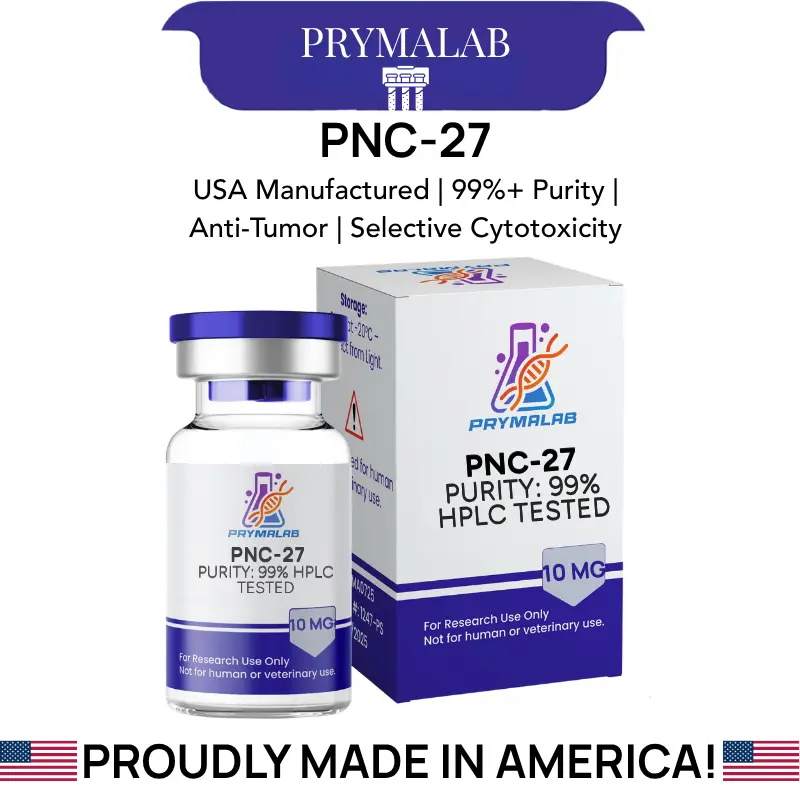
PNC-27 10mg is an extended-supply lyophilized vial of the 32-residue chimeric p53-penetratin peptide, CAS 1159861-00-3, molecular weight 4031.72. Ten milligrams corresponds to approximately 2.48 micromoles, twice the standard fill, intended for programmes running long enough that lot continuity matters.
Specification Table
PNC-27 verified data, 10mg extended-supply format
| Property |
Value |
| Compound |
PNC-27 |
| Vial content |
10 mg lyophilized powder |
| Molar content of vial |
Approximately 2.48 µmol |
| Stock at 2 ml diluent |
Approximately 1.24 mM |
| Stock at 5 ml diluent |
Approximately 0.5 mM |
| Compound class |
Chimeric synthetic peptide |
| CAS number |
1159861-00-3 |
| Molecular formula |
C188H293N53O44S |
| Molecular weight |
4031.72 g/mol |
| Residue count |
32 |
| Single-letter sequence |
PPLSQETFSDLWKLLKKWKMRRNQFWVKVQRG |
| N-terminal domain |
p53 residues 12 to 26, the HDM-2 binding region |
| C-terminal domain |
Penetratin, a membrane residency peptide from Drosophila antennapedia |
| Reported molecular target |
HDM-2 (human double minute-2), residues 1 to 109 |
| Reported in vitro observation |
Transmembrane pore formation and necrosis in cultured tumour cell lines |
| Originating group |
Pincus, Michl and colleagues, SUNY Downstate |
| Oxidation-prone residues |
Methionine at position 20, three tryptophans |
| Appearance |
White lyophilized cake |
| Purity |
Per lot-specific certificate of analysis |
| Solubility |
Water soluble. Dilute acetic acid also used |
| Storage, lyophilized |
-20°C, protected from light and moisture |
| Storage, reconstituted |
2-8°C, protected from light |
| Human clinical data |
None published |
| Regulatory status |
No approved human or veterinary formulation in any jurisdiction |
How Is Pore Formation Actually Measured?
The central in vitro observation for this compound is membrane permeabilisation, and several established assays report on it, each answering a slightly different question.
Dye exclusion is the simplest. Propidium iodide and similar membrane-impermeant fluorophores enter only cells whose membrane integrity has failed, so uptake indicates permeabilisation directly. It is quick and it does not distinguish pore formation from other routes of membrane failure.
Lactate dehydrogenase release measures the same event from the other side, and the enzyme leaks out of cells with compromised membranes, and the supernatant assay is quantitative. Because LDH release is the conventional necrosis readout, it also separates necrotic from apoptotic cell death.
Liposome leakage assays remove cells entirely. A synthetic vesicle loaded with a self-quenching dye releases it when the bilayer is breached, and running the peptide against liposomes with and without incorporated HDM-2 tests whether the target protein is required for the effect.
That last design is the most informative for this particular mechanism, because it isolates the proposed protein dependence from everything a living cell contributes.
What Analytical Confirmation Suits a 32-Residue Construct?
PNC-27 10mg justifies more analytical attention than the smaller fill, and this sequence has features that make several checks worthwhile.
Mass spectrometry confirms molecular weight at 4031.72. Watch for satellite peaks 16 daltons above, indicating oxidation at the methionine or one of the three tryptophans. With four oxidisable residues in 32, a small oxidised fraction is expected and a large one is grounds for questioning the lot.
Reversed-phase chromatography establishes purity. At 32 residues, synthesis produces deletion sequences differing by a single residue, and those can co-elute with the target unless the gradient is well resolved. A purity figure from a poorly resolved chromatogram overstates what it measures.
Absorbance at 280 nm is unusually informative here. Three tryptophans give a strong signal, so concentration determination requires no standard curve once the extinction coefficient is known.
Amino acid analysis is worth considering for a construct of this kind, since it confirms composition independently of the synthesis record and would detect a gross error in either domain.
How Should PNC-27 10mg Be Divided?
Reconstitute PNC-27 10mg once, aliquot immediately, freeze the aliquots, thaw each once. The order matters more than the specific volumes.
Ten milligrams into 2 ml gives approximately 1.24 mM, matching what a 5mg vial in 1 ml produces, which keeps dilution arithmetic identical between the two formats.
Aliquot size should match single-experiment consumption. For a compound with four oxidation-prone residues, the argument for avoiding repeat thaws is stronger than for a durable short peptide, because each round exposes the material to air and to temperature transitions.
Low-binding consumables matter throughout. The penetratin domain is highly basic, carrying multiple lysine and arginine residues, and basic peptides adsorb readily to standard plasticware. The proportion lost rises as concentration falls, which is precisely the range most cell work operates in.
What Does the Provenance of the Literature Mean?
Almost the entire published record behind PNC-27 10mg for PNC-27 comes from one group, and stating that plainly is more useful than letting the citation count imply breadth.
Pincus, Michl, Bowne and their collaborators at SUNY Downstate and affiliated institutions produced the structural work, the cell-line characterisation, the membrane HDM-2 detection and the mitochondrial interaction findings. The work spans roughly two decades and is internally consistent.
Internal consistency across one group is a weaker form of evidence than convergence across independent groups. That is not a criticism of the science. It is a statement about what kind of confidence the evidence supports.
For a researcher, the practical implication is that replicating a key finding independently has more value here than extending it. A confirmation of membrane-localised HDM-2 in a defined cell line, from a laboratory with no connection to the originating group, would strengthen the field more than another downstream observation.
No human clinical study has been published, and no approved formulation exists anywhere.
What Does the Penetratin Domain Contribute Beyond Delivery?
Cell-penetrating peptides are usually treated as inert carriers, and the published account of this construct suggests that framing is incomplete here.
Penetratin derives from the third helix of the Drosophila antennapedia homeodomain, a region that in its native context contacts DNA. Its cell-penetrating property was discovered incidentally, and the sequence carries a high density of basic residues that drive association with anionic membrane surfaces.
Membrane association is not the same as membrane transit. A peptide that binds a bilayer strongly may remain lodged in it rather than crossing, and at sufficient surface density basic amphipathic peptides perturb bilayer organisation directly.
That is why the term membrane residency peptide appears in descriptions of this construct rather than the more common cell-penetrating peptide. The distinction implies the sequence stays associated with the membrane rather than delivering cargo to the cytosol and departing.
For the proposed mechanism, membrane residency is the useful property rather than an incidental one, and a peptide acting on a membrane-localised target gains from remaining at the membrane.
The experimental consequence is that penetratin cannot be treated as background. It is an active participant, and any design attributing an effect to the p53 domain must show that the penetratin domain alone does not reproduce it.
How Should Concentration Ranges Be Chosen Without a Binding Constant?
No published dissociation constant for this construct against membrane HDM-2 is available, which removes the usual basis for choosing concentrations and calls for a different approach.
Working backward from published cell-culture concentrations is the common practice and the weakest, because it propagates whatever the first study chose without independent justification. It also anchors on a concentration selected for an effect rather than for mechanistic relevance.
A broad logarithmic range is the defensible alternative. Covering four orders of magnitude establishes where the response begins and whether it saturates, and both features carry mechanistic information a single concentration cannot.
A saturating response supports a specific interaction with a finite number of sites. A response that continues rising without saturation across a wide range suggests a non-saturable process, which for a membrane-active peptide points toward physical bilayer disruption rather than target binding.
That distinction is directly testable with material at this scale, and it addresses the central mechanistic question about this compound more efficiently than adding another downstream endpoint would.
What Makes PNC-27 10mg the Right Fill for a Long Programme?
Lot changes introduce a variable that is easy to overlook and hard to remove afterward.
A 32-residue construct with two functional domains is synthesised with an efficiency that varies between runs, and the impurity profile varies with it. Deletion sequences, oxidised species and incompletely coupled fragments are all present at levels that differ from lot to lot.
Where a programme spans several months, PNC-27 10mg keeps that variable fixed. Every experiment in the series draws from the same synthesis, so a difference between early and late findings cannot be attributed to the material.
The cost is that a single lot carries a single set of defects. If a lot proves poor, the whole programme rests on it.
Characterising the lot properly before committing to it resolves the tension, and PNC-27 10mg supplies enough material that a full analytical workup consumes a negligible fraction.
Reconstitution and Storage in Laboratory Practice
Decide the stock concentration before opening. Two millilitres gives approximately 1.24 mM and keeps calculations consistent with the 5mg format.
Add diluent gently against the vial wall and allow dissolution without vigorous agitation. Water dissolves this peptide, and dilute acetic acid is also used where solubility proves difficult.
Minimise air exposure given the oxidation-prone composition, and consider purging headspace with inert gas for aliquots held long term. Protect from light throughout, since tryptophan is photosensitive as well as oxidation-prone.
Hold lyophilized material at -20°C, sealed and dark. Record lot, diluent, volume, the concentration obtained, aliquot scheme and date. With ten milligrams spread across many tubes, the record is the only thing linking a late finding to the material that produced it.
Published Literature
References verified against the publisher record or a primary index. The concentration of this literature in one research group is discussed above and should inform how it is read.
- Sarafraz-Yazdi E, Bowne WB, Adler V, Sookraj KA, Wu V, Shteyler V, Patel H, Oxbury W, Brandt-Rauf P, Zenilman ME, Michl J, Pincus MR. Proceedings of the National Academy of Sciences. 2010;107(5):1918-1923. PMID: 20080680
- Michl J, Scharf B, Schmidt A, Huynh C, Hannan R, von Gizycki H, Friedman FK, Brandt-Rauf P, Fine RL, Pincus MR. International Journal of Cancer. 2006;119(7):1577-1585.
- Do TN, Rosal RV, Drew L, Raffo AJ, Michl J, Pincus MR, Friedman FK, Petrylak DP, Cassai N, Szmulewicz J, Sidhu G, Fine RL, Brandt-Rauf PW. Oncogene. 2003;22(10):1431-1444.
- Bowne WB, Sookraj KA, Vishnevetsky M, Adler V, Sarafraz-Yazdi E, Lou S, Koenke J, Shteyler V, Ikram S, Harding MA, Bluth MH, Frenkel S, Michl J, Zenilman ME, Pincus MR. Journal of Cellular Biochemistry. 2008;104(2):595-604.
- Sarafraz-Yazdi E, Gorelick C, Wagreich AR, Salame G, Angert M, Gartman CH, Gupta V, Bowne WB, Lee YC, Abulafia O, Pincus MR, Michl J. Journal of Oncology. 2018;2018:9483805.
Frequently Asked Questions
What is PNC-27 10mg?
An extended-supply lyophilized vial of the 32-residue chimeric p53-penetratin peptide, CAS 1159861-00-3, molecular weight 4031.72. Ten milligrams is approximately 2.48 micromoles, twice the standard fill. Supplied for laboratory research only, with no approval for human or veterinary use.
How is membrane permeabilisation measured?
Several ways. Dye exclusion using propidium iodide detects loss of membrane integrity directly. Lactate dehydrogenase release measures the same event from outside the cell and separates necrotic from apoptotic death. Liposome leakage assays remove cells entirely from the question.
Which assay best tests the proposed mechanism?
Liposome leakage with and without incorporated HDM-2. That design isolates the proposed protein dependence from everything a living cell contributes, and it directly tests whether the target protein is required for the membrane effect rather than inferring it.
What should mass spectrometry show?
A principal peak at 4031.72. Watch for satellites 16 daltons above, indicating oxidation at the methionine or one of three tryptophans. With four oxidisable residues in 32, a small oxidised fraction is expected and a large one warrants questioning the lot.
Why is chromatographic resolution important here?
Because at 32 residues, solid-phase synthesis produces deletion sequences differing from the target by a single residue, and those can co-elute unless the gradient resolves them properly. A purity figure from a poorly resolved chromatogram overstates what it actually measured.
What reconstitution volume keeps calculations consistent?
Two millilitres, which gives approximately 1.24 millimolar and matches what a 5mg vial reconstituted into 1 ml produces. Dilution arithmetic then transfers between the two formats without adjustment, which is worth doing if a programme uses both.
Why do low-binding consumables matter?
The penetratin domain carries multiple lysine and arginine residues, making the peptide highly basic, and basic peptides adsorb readily to standard plasticware. The proportion lost rises as concentration falls, which is exactly the range most cell-based work operates in.
Where does the literature come from?
Almost entirely from one group at SUNY Downstate and affiliated institutions, spanning roughly two decades, and the work is internally consistent, which is a weaker form of evidence than convergence across independent laboratories. That is a statement about confidence, not a criticism of the science.
What would strengthen the evidence base?
Independent replication rather than extension. A confirmation of membrane-localised HDM-2 in a defined cell line, from a laboratory unconnected to the originating group, would do more for the field than another downstream observation from within it.
What storage conditions apply?
Lyophilized at minus 20 Celsius, sealed against light and moisture. Reconstituted at 2 to 8 Celsius in the dark, aliquoted before the first freeze. Consider purging headspace with inert gas for long-term aliquots, given four oxidation-prone residues in the sequence.
Compliance Statement
PNC-27 10mg is sold exclusively for laboratory research use. It is not a drug, food, or cosmetic product, and it is not a dietary product of any kind. It is not approved by the FDA or any comparable authority for human or veterinary use, no human study of this compound has been published, and all reported findings are in vitro or cell-culture observations. This product is not intended to diagnose, treat, cure, or prevent any disease. It must not be given to humans or animals. Purchase is restricted to qualified researchers and institutions operating within applicable laws. All handling is the responsibility of the purchasing laboratory.














Reviews
There are no reviews yet.